
pricenxt_graue_schrift_icon
Methodology

From market signal to reliable price

Every price in pricenxt follows a clear path: our team of experts collects the data directly in contact with a wide range of market players and uses it to calculate a reliable price reference for each material price series.

For better negotiations. More reliable calculations. Faster decisions.

Team discussing market data in a conference room
From the market. Week by week. Month by month.

Where does our price information come from?

The price information in pricenxt comes from the established industry service Kunststoff Information (KI) and is researched directly in the market.

It is based on a proven two-pillar methodology of broadly collected market data and personal industry conversations, complemented by statistical methods for evaluation and assessment.

Continuous market surveys

Our market surveys on the development of polymer prices run continuously via our in-house survey tool PriceDesk. We survey registered and trusted market players – in particular plastics converters, but also producers, compounders, recyclers, distributors, system suppliers, and traders.

The market data collected feeds into the determination of monthly contract prices and weekly spot prices. This creates a broad, up-to-date picture of actual price developments in the market.

Checklist being completed with a stylus on a laptop
Market analyst conducting a phone interview with a headset

Personal market interviews

Personal conversations provide the context behind the prices.

The Kunststoff Information price team is in continuous direct contact with a fixed panel as well as changing market participants, based on a network along the plastics value chain that has grown over decades.

In addition to actually traded prices for primary and secondary materials, we record the market situation, supply and demand as well as price expectations and current influencing factors.

This allows us to put individual price reports into context, recognise market developments early and paint a differentiated picture of the actual price situation.

International partner networks

For selected markets in Central Europe and China, Kunststoff Information works with experienced partners, and correspondent networks on the ground.

Their regional market knowledge and price information complement our ongoing market monitoring and broaden the view of price developments in key international plastics markets.

Two experts discussing market data in front of a chart screen
From research to analysis

Market data becomes reliable price information
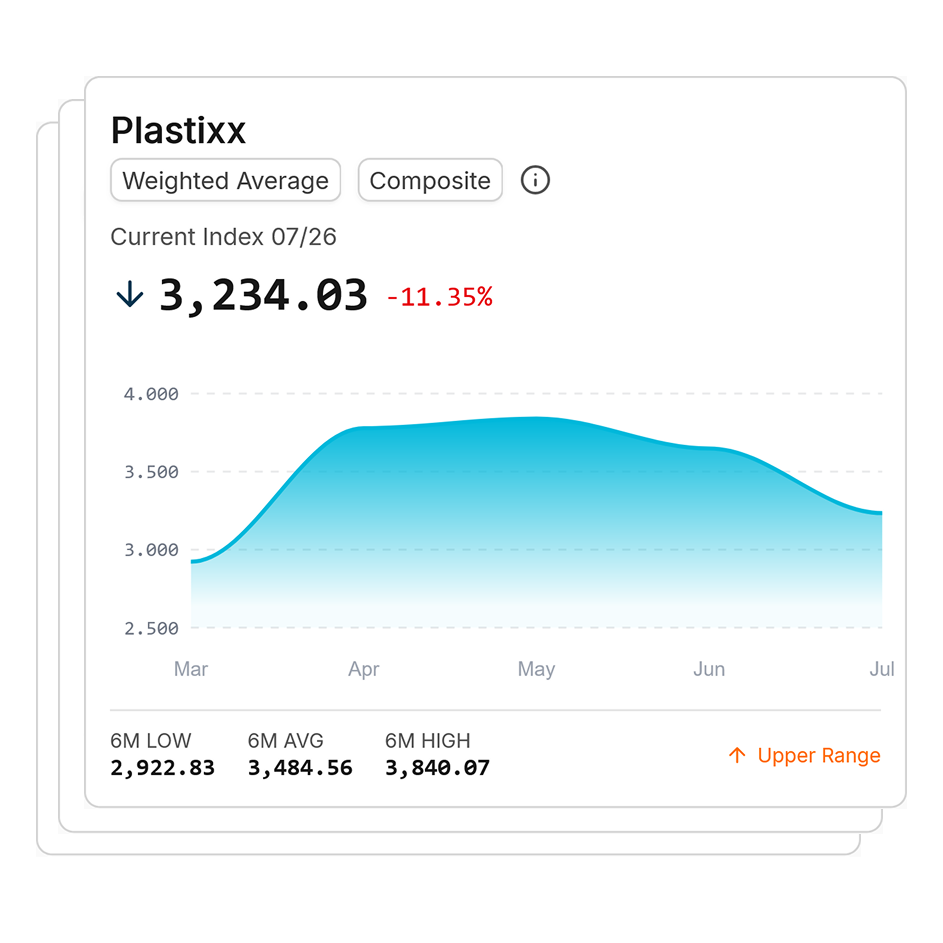
Diagram showing how market data becomes reliable price information
  • How our reference prices are created

    Kunststoff Information continuously collects and checks price reports from the market, puts them into context and condenses them into reliable reference prices.

    pricenxt makes this price information interactively usable: in charts, price cards, comparisons, forecasts and individual boards for your own market analysis.

  • Contract and spot prices from the market

    The focus is on Western European contract prices from ongoing supply relationships. They are usually reported as monthly average prices for the respective reporting period.

    In addition, pricenxt publishes weekly spot prices for short-term individual transactions outside existing supply agreements. This covers both longer-term contract markets and short-term market movements.

    Gross contract prices for free delivery are taken into account – excluding discounts, cash discounts, bonuses, other net settlements, and VAT.
Comparable price basis

Clear conditions for every price series

Prices are reported according to the conditions and reference units defined for each price series. Depending on the material and market, we take typical purchase volumes, supply channels, and forms of trade into account.
  • Standard thermoplastics

    Typical individual purchases in full truckloads of around 20 t.

  • Engineering thermoplastics

    Typical individual purchases of ready-to-use materials via distributors, usually between 3 and 10 t.

  • Polyurethanes and composites

    Typically smaller individual purchases, usually on a pallet basis.

  • Regranulates

    Typical individual purchases of standard grades traded in Western Europe from 1 t. 

Reflecting the range of the market

For each price series, the Kunststoff Information price team determines a price range for the respective reporting period. It reflects the spread between the lower and upper price levels identified in the market.

Two sources of information feed into the assessment: price reports via our PriceDesk and direct dialogue with market players.

Price reports via our PriceDesk

Prices reported continuously by registered and verified market participants.

Direct dialogue with the market

Price information and assessments from personal conversations with market players.

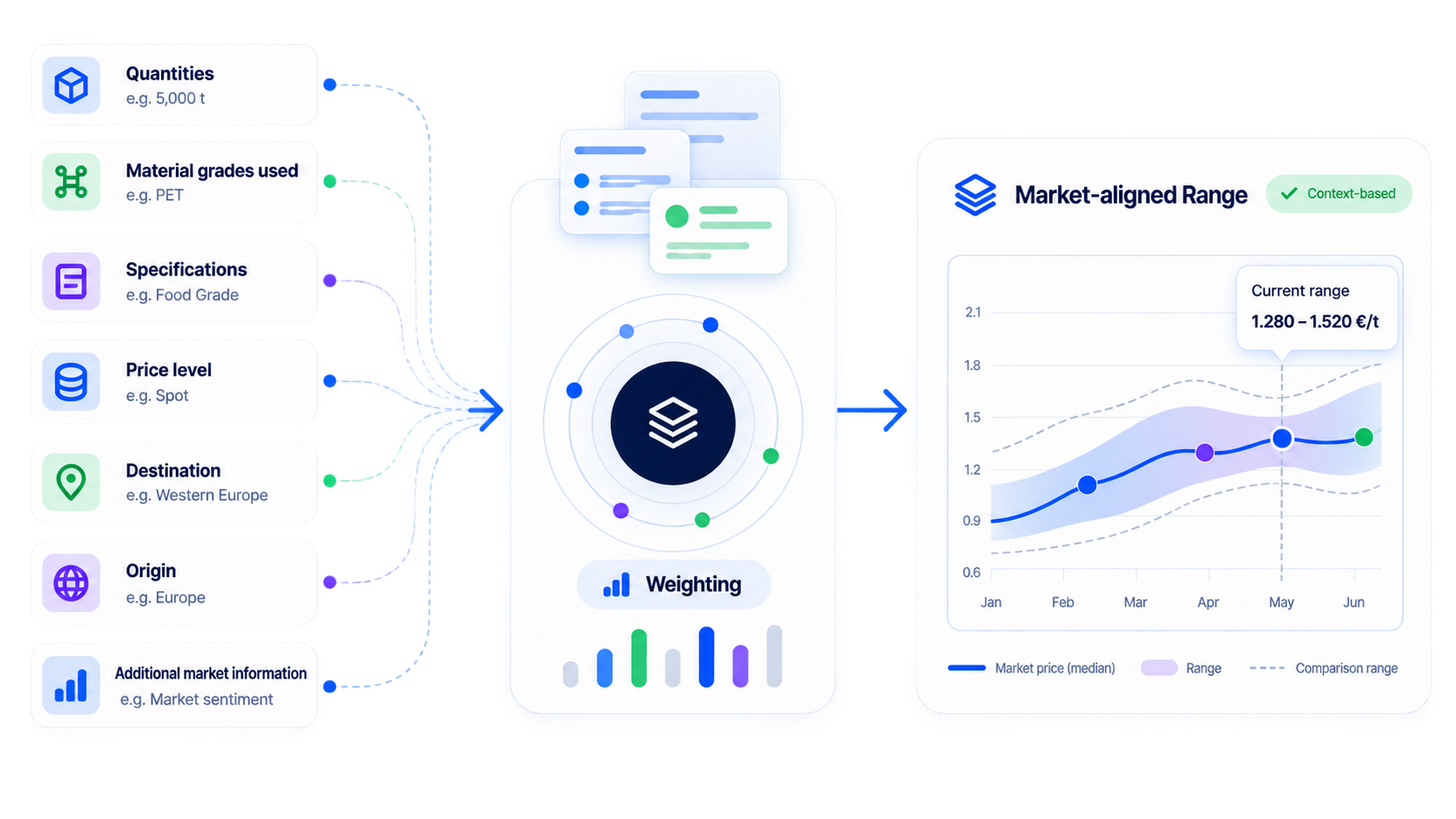
Diagram: quantity, material grade, specification, price level and region combine into a market-aligned price range

Context determines the weighting

Not every price report is directly comparable. That is why the price team takes various factors into account when assessing and weighting the data:

  • Purchase volume
  • Material and grade
  • Specification
  • Price level
  • Destination
  • Origin
  • Other relevant market information

These factors feed into the weighting of the individual data points. This creates a range that is close to the market.
Editorial expertise

The team behind the prices

The price data collected is checked, assessed, and validated by the Kunststoff Information price team. The market analysts combine current price reports and direct market contacts with many years of experience and statistical evaluations.

This results in reliable reference prices and market reports that put the current situation in the plastics market into context.

The resulting reference prices and market information form the data basis for your analyses in pricenxt.

Three editorial team members discussing price data at a screen
Direct dialogue on an equal footing

Become part of our market network

Do you work in plastics procurement or sales and know current prices first hand? Share your market assessment with our price team and become part of our network of market participants. 

In return, you stay in regular contact with our market analysts and benefit from current assessments and in-depth expert discussions at the highest level.

Your questions about our methodology. Clearly answered.

See how price information is created, checked, and used in pricenxt.

The price information is compiled independently and reliably by the price team at “KI – Kunststoff Information”.

The data comes mainly from online surveys in KI’s own online tool “PriceDesk” and from telephone interviews. It is complemented by additional regional sources and market research carried out by KI’s specialist editorial team.

The first pillar is the monthly online survey in “PriceDesk”.

The second pillar is personal telephone interviews with a fixed panel and a changing set of market contacts.

Together they provide both breadth and depth.

These include converters, producers, compounders, recyclers, distributors, system suppliers, and traders.

The prerequisite is registration in “PriceDesk”.

The price team talks to market participants about the market situation, regranulate prices, primary material, secondary material, and price expectations.

These conversations help to put the raw price data into context.

As a rule, Western European average prices on a contract basis for the stated period.

The basis is gross prices for delivery free domicile — excluding discounts, cash discounts, rebates, other net settlements, and VAT.

Spot prices refer to commodities traded outside contractually agreed volumes.

They are published weekly and usually quoted for one or two 20-tonne loads. Prices are given in EUR/t, net-net, excl. VAT.

First, the price team determines a market-based price range for the relevant polymer type and period.

The arithmetic mean of this range forms the reference price.

The reference price appears in price charts and is used to calculate the “Plastixx” polymer price indices.

Within pricenxt, it can be used for analyses, comparisons, and price movements.

Volumes, grades, specifications, price level, destination, origin, and further market assessments.

These factors help to interpret individual price data correctly.

From a product’s monthly reference prices.

Kunststoff Information looks at the difference from the respective previous month over the course of a year. The standard deviation is then calculated from these absolute deltas.

From correspondents and cooperation partners in the respective regions.

The data follows the market standards recognised there.

Yes. If you regularly purchase plastics raw materials or supply plastics in Western Europe, the price team would be glad to hear from you.

Web: https://pieweb.plasteurope.com/default.aspx?pageid=209
Email: preisteam@ki.de
Phone: +49 (0) 6172 / 9606-33

Still have questions? We’re here to help.

Our team will show you how to use pricenxt for your market and price analysis.

Get in touch